Wordless … at the End of History
Performance Solo
Wordless, A Conversation with Samuel Beckett and Morton Feldman at the End of History
Years of realization: 2018–2019
Format: Performance Instrument & Installation
Commissioned by: Asko-Schönberg Ensemble
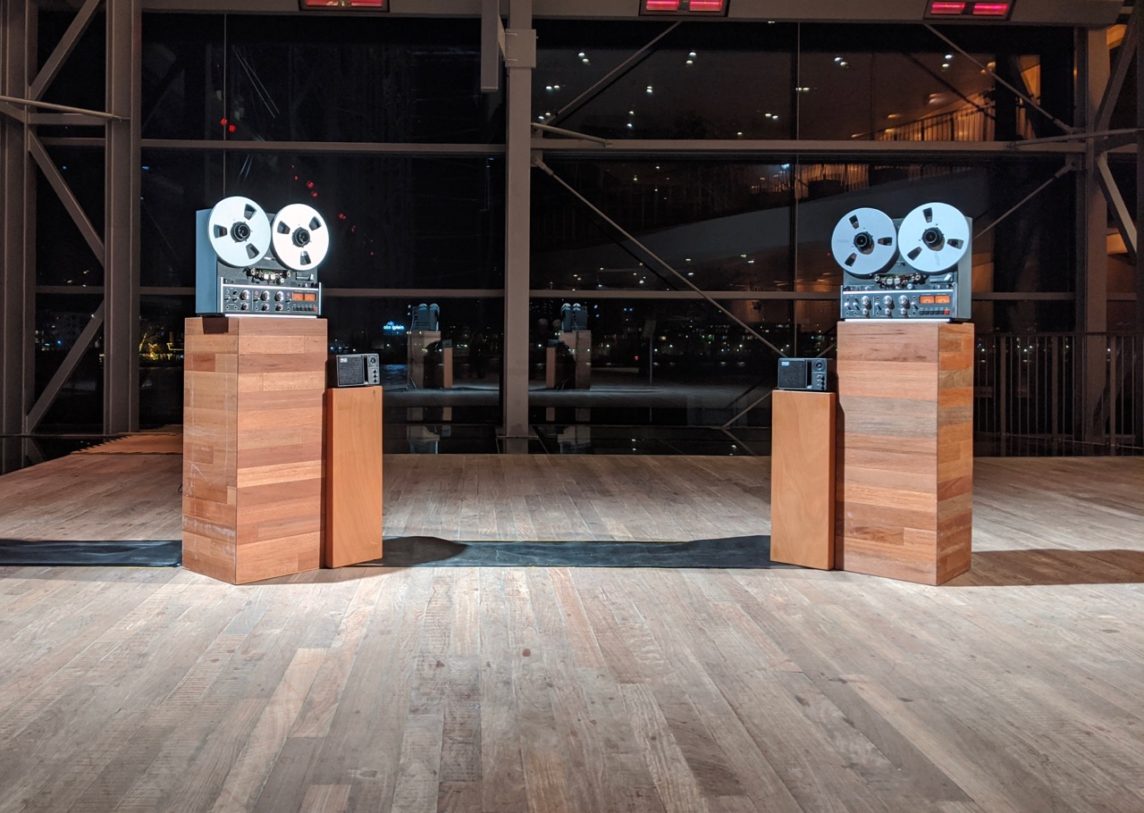
Wordless … at the End of History is a sound installation and live performance instrument that stages an impossible dialogue between Samuel Beckett and Morton Feldman through early deep-learning text-to-speech systems. Conceived at a moment when neural voice synthesis was still fragile, data-hungry, and opaque, the work aimed to explore how these technical limitations could be developed as an artistic position resonating with values of the two artists.
At the core of the work are two text-to-speech models trained on the publicly available recordings of Beckett and Feldman’s voices, which reflect the different philosophies on publicity and recording technologies of the two artists. In both installation and performance, a computer generates text for each model and controls two robotically operated reel-to-reel tape machines. Each newly generated utterance is recorded, played back, and then repeatedly overdubbed onto magnetic tape. This destructive, material process progressively erodes intelligibility, transforming language into a dense, textural soundscape of decaying, voice-like traces. The tape machines act as both memory and entropy engine, mirroring how digital systems endlessly replay and degrade cultural material while obscuring its origins.
Samuel Beckett was notorious for actively resisting having his voice or likeness recorded on any media – leaving only a few minutes of his recorded voice available in the public domain. In contrast, Feldman was a proponent of broadcast radio and audio recording as a medium for communication, producing hours of recorded conversations and public lectures, most notably with his fellow American composer John Cage. The extreme asymmetry in available recorded voice, mirroring these two artists’ value systems and philosophy, leads to the two text-to-speech models being vastly different in their ability to produce intelligible speech. The Beckett model produces ethereal, abstract voice-like sounds which in some ways resemble their origins; while the Feldman model produces an almost uncannily realistic simulation of the composer’s recognizeable voice.
While the Feldman model was trained using standard methods. The Beckett voice model deliberately employs overfitting as a strategy, being pushed to memorise and exaggerate its tiny dataset, producing unstable, distorted, and fragmentary vocal output. What emerges is not a convincing vocal replica, but a strained, haunted signal: a voice that reveals its own impossibility.
The textual material spoken by the models is drawn from a deliberately impure archive. I constructed a web-scraped corpus consisting primarily of Amazon.com user reviews, forum discussions, critical commentary, lecture transcripts, and publicly available writings related to the work of Beckett and Feldman. These fragments – expressions of reception, opinion, misunderstanding, admiration, and projection – are stochastically recombined into an endless pseudo-conversation. The models do not in any way “speak for” the artists, but instead vocalise a sedimented social afterlife: how their work circulates, mutates, and is spoken _about_ online long after authorship has dissolved into data.
Live Performance
In its original form, Wordless functioned primarily as a live performance installation. Premiered at the Muziekgebouw Amsterdam during the 2019 Words and Music Biennale, the work was performed through live coding and real-time manipulation of both the voice models and tape machines. Across several short performances, I collaborated with Dutch spoken-word poets Stokely Dichtman and Justin Samgar, weaving their live voices into the AI-generated fragments. These sessions foregrounded liveness, risk, and irreversibility: every utterance permanently altered the sonic memory of the system.
Installation Iterations
A later, fundamentally altered iteration was presented in Graz in 2021 as a two-screen installation. This version presented a pre-rendered dialogue between the two models, with synchronised text displayed on monitors. While this format emphasised the uncanny character of the synthetic voices, it functioned primarily as documentation of a single possible output, rather than as an expression of the work’s core performative logic.
The full potential of Wordless lies in a durational, public installation that preserves the instrument’s liveness: a system that continues to speak, overwrite itself, and decay in real time.
Reflection; 06 January 2026
Much has happened in the world since 2018 when I made this installation. Wordless … at the End of History predates the current state of high-fidelity generative AI voice systems. The makers of these tools prioritize seamless imitation and operation at scale. Interestingly, the dominant voice synthesis paradigm in the data-driven AI landscape has been to create legal abstractions made possible by claiming that a model trained on thousands of voices is not really copying those voices, but “learning what voice is”. This is the “bag of voices” approach. Looking back on working with the early neural voice synthesis architectures on Wordless – it always felt that the models themselves were insisting on friction and failure. Today the software architectures are so much more robust and resilient against model collapse – a common failure in the training process of early gen AI systems. What was often frustrating, I now imagine as a certain type of ethical engagement. That to work ethically with AI voice may sometimes require worsening the model rather than improving it – allowing technical artefacts to signal absence, consent, and disjunctures in time the way an old recording sounds old and like a recording. Or, rather than intentionally creating voices that cannot be proven to immitate any one specific human, intentionally creating voices that do not sound human at all. At this moment, where synthetic voice clones are widely circulating without bodies, accountability, or context, Wordless feels more and more like a meditation on what it means to listen to voices: those that eagerly wish to be heard, and those that wish for their absence to be felt.